Quiet Work. Real Momentum.
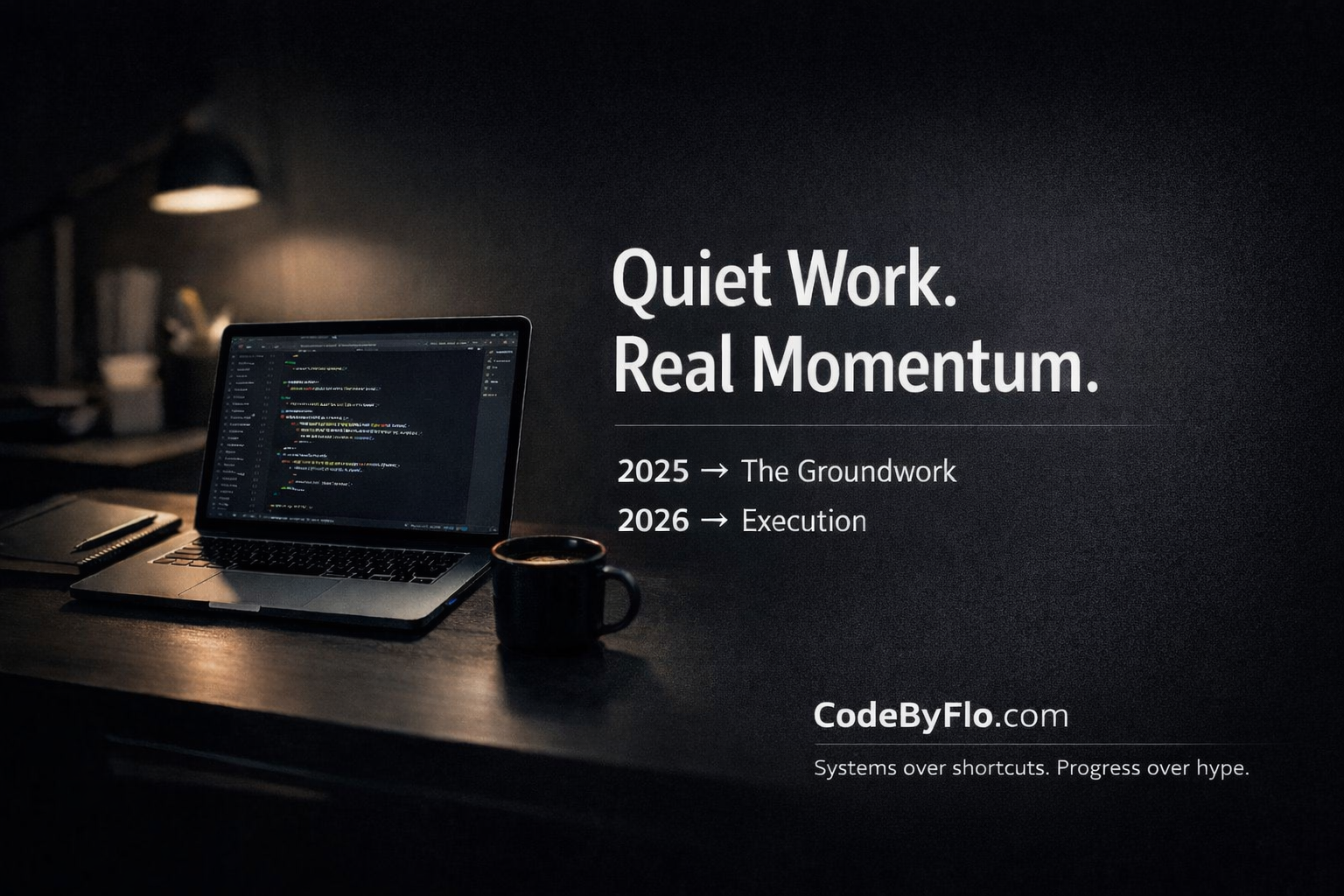
Quiet work. Real momentum. Building systems that compound over time.
If you’re new to software, here’s something that doesn’t get said enough: you don’t need a perfect roadmap, you need a repeatable system. A way to show up, build, test, ship, and learn… even when motivation isn’t there.
I started coding a long time ago. I’ve shipped projects in multiple industries, taught technical training, and spent years building systems that had to work in the real world , not just in demos. And even with all that experience, the same truth keeps showing up: progress comes from consistency, not intensity.
What 2025 really taught me
2025 was one of those years where the results didn’t come from one big moment , it came from stacking a lot of small, correct decisions.
- Shipping beats talking. The fastest way to get clarity is to build something real and put it in front of people.
- Simplicity scales. The best systems are the ones you can maintain when you’re busy, tired, or under pressure.
- Constraints are a superpower. Limited time forces you to prioritize what actually moves the product forward.
- Quality is a habit. Clean code, clear UI, strong workflows , those aren’t “extra.” That’s the product.
If you’re learning right now, don’t underestimate what happens when you do the basics well for a year straight: fundamentals, small projects, clean execution, and consistent reps. That’s how people quietly level up.
Build the habit. Ship the work. Let the timeline tell the story.
What I worked on in 2025
A lot of my time went into shipping and refining products , not just writing code, but building the full system: user flows, operations, edge cases, performance, and what happens after launch.
- Platform work: shipping and iterating on real products, improving reliability, workflow clarity, and performance.
- Automation & tooling: tightening up internal tools so building and publishing is faster and less error-prone.
- Teaching: continuing to shape practical content that helps people build real skills, not just memorize tutorials.
- Open-source: preparing projects that are useful, clean, and focused , the kind of repos I wish I had when I started.
The theme was the same across everything: fewer shortcuts, better systems.
If you’re a new developer, do this
Here’s a simple framework that works whether you’re learning Python, web dev, mobile, or anything else:
1) Pick one small project and finish it
Not ten projects. One. Something you can complete, deploy, and explain. “Finished” is a skill , and it’s rare.
2) Build the boring parts on purpose
Auth. Forms. Validation. Error handling. Logging. Deployments. This is where most developers get stuck , so this is where your advantage is.
3) Write code like future-you is the customer
Clear names. Small functions. Consistent structure. The goal isn’t cleverness , it’s maintainability.
4) Keep a “done list”
Motivation comes and goes. Evidence doesn’t. Track what you shipped each week.
What’s next for 2026
2026 is about momentum: shipping multiple projects, tightening the systems behind them, and sharing more of the process through development tutorials and open-source launches.
- More shipping: more releases, more iteration, more real-world feedback loops.
- Tutorials: practical dev walkthroughs focused on patterns that actually hold up in production.
- Open-source: smaller, sharper projects that help other builders move faster.
- Business travel: getting back into rooms where real deals and real partnerships happen.
If you’re early in your journey, don’t compare your chapter one to someone else’s chapter twenty. Just keep building. Keep shipping. Keep learning.
If you want to follow along, check back on the What’s New page.